
3,000-Year-Old ‘Screaming’ Mummy: Scientists Investigate the Mystery
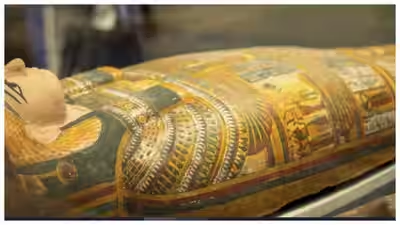
An unnamed woman whose mummy was discovered in Thebes in 1935 has puzzled researchers for decades because of her open-mouthed, contorted expression. A 2024 scientific examination using CT scans, X-rays and laboratory techniques found no clear cause of death, but researchers suggested that a cadaveric spasm may have preserved the unusual facial position.
Key Takeaways
- Strategic developments align with India's long-term infrastructure and technology trajectory.
- Institutional market observers point to sustained corporate expansion and regulatory certainty.
An unnamed Egyptian woman buried around 3,000 years ago has continued to puzzle researchers because of an unusual expression preserved on her face. Her mouth remains open and her features appear contorted, giving the mummy the appearance of someone caught in a scream.
The mummy was discovered in Thebes in 1935. With no identifying inscription on her coffin, researchers have been unable to establish her identity.
For decades, one of the main questions surrounding the remains was whether the expression resulted from poor embalming. A later scientific examination, however, found evidence that the woman had received an elaborate and expensive burial treatment.
Mummy discovered in Thebes in 1935
The woman's remains were found in an ancient Egyptian burial site in Thebes. Her coffin did not carry an inscription identifying her.
Her unusual facial position immediately attracted attention. Unlike the carefully preserved expressions usually associated with Egyptian mummies, her mouth was left open and her face appeared frozen in an intense expression.
Researchers initially considered whether the appearance could have resulted from problems during the mummification process.
The evidence from her burial, however, points to a more carefully conducted embalming process.
Expensive materials used during burial
The woman was buried with materials associated with a costly mummification process.
Her elaborate wig was made using date palm fibres and had been treated with reddish henna. Researchers also found a crystalline coating containing quartz, magnetite and albite.
Imported resins were used on her body, clothing and wig. Among them was frankincense associated with Punt, a region known in ancient times for valuable products including aromatic resins and gold. Juniper resin was also identified.
These materials indicate that considerable resources were used in preparing the woman's body for burial.
The position of her arms also provides clues about her social status. Her arms rested beside her body and only partially crossed over her lap. Researchers said this differs from the crossed-arm position commonly associated with royal Egyptian mummies.
Why does the Egyptian mummy appear to be screaming?
One unusual feature of the remains is that the woman's internal organs were still present.
In many ancient Egyptian mummification practices, organs were removed and preserved separately. However, embalming practices changed over time, and some later techniques involved drying organs and returning them to the body.
Researchers did not find a visible incision indicating that her organs had been removed.
The unusual condition of her face remains the central mystery.
Scientists examine the mummy using modern technology
In 2024, mummy radiologist Sahar Saleem of Cairo University and Samia El-Merghani of Egypt's Ministry of Tourism and Antiquities conducted a detailed examination.
The researchers used several non-destructive techniques, including X-rays and CT scans. They also conducted scanning electron microscopy, Fourier-transform infrared spectroscopy and X-ray diffraction analysis.
The examination estimated that the woman was around 5 feet tall and approximately 48 years old when she died.
Researchers found signs of wear affecting her teeth and joints. However, the examination did not identify a definitive cause of death.
Cadaveric spasm may explain the expression
The researchers proposed that a phenomenon known as a cadaveric spasm could have contributed to the mummy's unusual facial position.
A cadaveric spasm refers to an uncommon phenomenon in which certain muscles can become fixed at the moment of death. Unlike rigor mortis, which generally develops after death and affects muscles more broadly, a cadaveric spasm can preserve a particular posture immediately at the time of death.
Researchers suggested that severe pain or panic could be associated with such a phenomenon.
However, this remains a proposed explanation rather than a confirmed cause of the woman's facial expression or death.
The mummy therefore continues to offer researchers a rare glimpse into ancient Egyptian burial practices while leaving one central question unresolved: what exactly happened to the woman at the end of her life?
Mumbai Weekly Staff
Editorial correspondent reporting on national and global stories for Mumbai Weekly.
More In Research
View All Research →
Trees Can Sense Their Own Shape and Correct Their Posture, Scientists Discover
Researchers from INRAE and the University Clermont Auvergne have found that young poplar trees can detect changes in the curvature of their stems and adjust the formation of specialised tension wood to correct their posture.