Delhi PG Safety Under Scrutiny After Satya Niketan Collapse, Students Demand Stricter Checks
The collapse of a five-storey PG building in Delhi's Satya Niketan that killed seven people has raised fresh questions about building safety, illegal construction and the regulation of paying guest accommodations. Students and young professionals say affordability often limits their housing choices, while the Delhi government is preparing a policy that could introduce licensing, verification, CCTV, wardens and rent regulation for PG operators.
Key Takeaways
- Strategic developments align with India's long-term infrastructure and technology trajectory.
- Institutional market observers point to sustained corporate expansion and regulatory certainty.
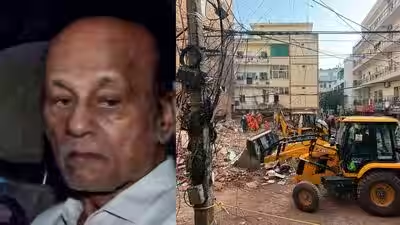
The collapse of a five-storey paying guest building in Delhi's Satya Niketan has brought renewed attention to the safety of PG accommodations across the Delhi-NCR region. The September 6 incident, which claimed seven lives, has left students and young professionals questioning whether the buildings they depend on as their second homes meet basic safety standards.
For thousands of people who move to Delhi for education and employment, PG accommodation is often selected on the basis of rent, food, internet access and proximity to colleges or workplaces. Building approvals, structural safety and emergency arrangements may receive far less attention.
The Satya Niketan incident has changed that calculation.
Investigation points to alleged unauthorised construction
According to the FIR in the case, property owner Hariram Gupta and his brother allegedly added four floors to an older building despite being aware that its foundation could not support the additional load.
The structure was more than four decades old and had reportedly been repaired before being converted into a PG. Police are also examining allegations that a load-bearing wall was removed while construction work was being carried out.
The property was leased to the PG operator Hostel Daze in August 2025, according to information cited in the investigation. Police are also examining the ownership and possession documents associated with the property.
Sources cited in the report estimated that the building generated more than Rs 4 lakh in monthly revenue.
Investigators are also looking into the alleged network of private intermediaries operating in the area, sometimes described as a "PG mafia", which may facilitate construction and PG operations on commission.
Police intensify search for property owner
Delhi Police deployed more than 10 teams to locate Hariram Gupta after the collapse. Officials said he was not present at his Gurgaon residence when police teams arrived.
Technical surveillance was subsequently used to trace his movements, while a lookout circular was issued to prevent him from leaving the country.
The investigation is expected to examine not only how the building was constructed and operated, but also whether required permissions and safety requirements were followed before it began housing students.
Students are questioning the safety of their own PGs
The incident has prompted many residents to reassess the buildings where they live.
Sneha Mishra, who moved to Delhi from Deoghar in Jharkhand and lives in a girls' PG in Sant Nagar, said she had previously considered the accommodation her second home without thinking much about its structural condition.
After the Satya Niketan collapse, she said she began wondering whether the building residents trust with their lives is actually safe.
The concern is shared by families who send their children to Delhi for education, with many students now paying closer attention to the condition of their accommodation.
For residents, however, identifying a safer PG is not always straightforward.
Affordability makes safety harder to prioritise
Higher safety standards can often come with higher rents, creating a difficult choice for students and young workers on limited budgets.
Shilpashree Mondal, who lives in a PG in Noida, said affordability plays a major role in deciding where people live. She also raised concerns about issues such as poor hygiene, water supply problems and damp walls.
She said residents may discover these problems only after moving into a property because the condition presented by owners and caretakers may not always reflect the reality of the accommodation.
The problem is particularly relevant in areas where demand for affordable housing is high and students have limited alternatives.
Residents want access to building documents
Another concern raised by students is the lack of transparency over permissions and approvals.
Vijaya Roy, a student at Delhi University's Ramanujan College preparing for the CAT examination, said residents of her PG are not necessarily shown documentation proving that the property has the required permissions.
She argued that tenants should be able to access relevant documents so they can determine whether the property complies with applicable regulations.
Roy also pointed to the shortage of affordable hostel accommodation at educational institutions. More college-hostel capacity, she said, could give students alternatives and reduce their dependence on privately operated PGs.
Delhi plans tighter rules for PG operators
The Satya Niketan collapse has added urgency to efforts by the Delhi government to establish a comprehensive framework for PG accommodation.
Under the proposed policy outlined by Urban Development Minister Ashish Sood, PG operators would need a PG Operating Licence and would have to undergo police and municipal verification.
The proposed framework includes several safety and monitoring requirements.
CCTV cameras would be mandatory at entrances and common areas, with recordings required to be retained for 30 days. PGs housing at least 15 students would also need a licensed night guard between 10pm and 6am.
Visitor registers would be compulsory, while non-resident visitors would be permitted between 8am and 9pm.
The proposal also calls for every PG to have a warden either residing at the premises or maintaining an office within a 500-metre radius. The warden would be expected to be physically available within 15 minutes during an emergency.
Proposed policy also targets rent concerns
Safety is not the only issue being considered.
The proposed policy includes a Rent Regulation Committee that would determine rent bands for different areas. Factors such as occupancy, amenities, prevailing market prices and proximity to educational institutions and public transport would be considered when determining those bands.
A proposed Institutional Accommodation Committee would also bring together college officials, student representatives, municipal authorities and police representatives.
The aim is to create greater oversight of an accommodation sector that has become an important part of Delhi's student and young-professional housing market.
Satya Niketan changes how residents view PG accommodation
For many Delhi-NCR residents, the collapse has shifted the way they assess their living spaces. Issues that might previously have been overlooked, such as damp walls, crowded staircases, makeshift construction and emergency exits, are now receiving greater attention.
The incident has also exposed the tension between affordability and safety. Students and young professionals may need low-cost accommodation, but limited budgets can leave them with fewer choices when safer housing comes at a higher price.
As the investigation into the Satya Niketan collapse continues and Delhi considers tighter PG regulations, residents are increasingly asking for something basic: proof that the place they call home is structurally safe and legally authorised to house them.
Mumbai Weekly Staff
Editorial correspondent reporting on national and global stories for Mumbai Weekly.
More In India
View All India →
Prof. Dr. Arjun Chavan: A Scholarly Career Rooted in Hindi Literature and Research
After 38 years as a Professor and Head of the Hindi Department at Shivaji University, Kolhapur, Maharashtra, Prof. (Dr.) Arjun Chavan continues his literary work as an independent scholar and author. His career has covered Hindi literature, comparative literary studies, translation, research methodology, poetry, editing and academic research.