Meta Drops AI Usage Metrics From Engineer Performance Reviews
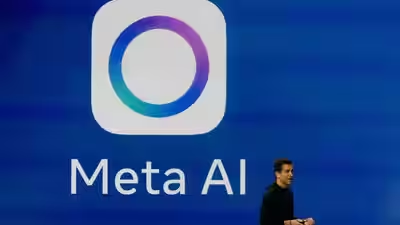
Meta has changed its performance review guidance for engineers, removing references that linked employee evaluations to AI usage and the internal AI Native designation. Managers are now being asked to focus on the impact of an engineer's work rather than AI adoption dashboards or token consumption.
Key Takeaways
- Strategic developments align with India's long-term infrastructure and technology trajectory.
- Institutional market observers point to sustained corporate expansion and regulatory certainty.
Meta has backed away from using AI usage as a direct measure of engineer performance, with new internal guidance telling managers to focus on the impact of employees' work rather than how frequently they use AI tools.
The revised performance review guidance removes language connecting evaluations with AI usage and the company's internal AI Native designation. Instead, it states that an employee's work can be supported by AI or other methods.
Three Meta employees described the change to Wired, while The Information reported that engineers had been told managers would not use AI adoption dashboards or token counts to assess their impact.
The change reverses a system that Meta had used for much of the previous year, when engineers were assessed partly through their AI-driven impact and placed into categories including AI Native, AI First and AI Enabled.
Meta's AI measurement system created pressure
Meta introduced its AI-focused performance standard nearly a year ago. Internal dashboards tracked employees' AI token consumption, and an employee-created leaderboard ranked workers according to how much AI they were using.
The system eventually became associated with what employees described as “tokenmaxxing”, where workers attempted to increase their AI usage so their dashboard figures would reflect stronger performance.
The leaderboard was removed in April after details of the system became public.
The push for greater AI adoption also resulted in increasingly elaborate use of AI agents within the company. Some employees created multiple agents, while others developed agents designed to identify and evaluate other agents.
New guidance shifts attention to actual output
Under the updated approach, managers are expected to assess what engineers accomplish rather than the specific tools they use to complete their work.
Meta spokesperson Tracy Clayton told Wired that the change was intended to emphasise that employees are evaluated based on their contributions. The company also said the AI Native designation had never been part of formal evaluations.
Some employees welcomed the revised wording, saying it could reduce pressure to use AI in situations where the technology does not provide a meaningful benefit.
However, the change does not appear to signal a broader retreat from AI adoption at Meta. Employees are still expected to demonstrate that they can use AI tools effectively, while internal AI usage continues to rise as engineers work with newer agentic projects such as Hatch.
AI push also raised concerns among employees
Meta's push to increase AI adoption extended beyond performance reviews.
The company held AI Transformation Weeks in March, encouraging employees in different roles to experiment with AI tools outside their usual areas of work. Designers were encouraged to try coding, while engineers were encouraged to explore design-related tasks.
Meta later limited AI usage after facing supply pressure.
The company's AI initiatives also included software installed on US employees' computers to collect keystrokes, clicks and screen content for model training. More than 1,000 workers reportedly signed a petition opposing the programme, which was subsequently paused.
The company's internal figures showed that code changes to internal systems increased 220% year over year, while changes that reached users rose 36%.
Those numbers highlighted a distinction between the volume of work generated with AI and the actual impact delivered to users.
Lawsuit adds to scrutiny over AI-based evaluations
Meta's earlier approach to AI-linked performance measurement has also become part of a legal dispute.
Around two dozen former employees sued the company in July, alleging that Meta violated US antidiscrimination law when it carried out layoffs in May. Workers who were on health or family leave argued that they could not build up AI usage metrics and were consequently disadvantaged.
Meta has denied the allegations, and the case remains ongoing.
The decision to remove AI usage and token counts from performance reviews could therefore ease some of the concerns surrounding the company's earlier measurement system, while leaving its broader expectation that employees adopt AI tools largely intact.
Mumbai Weekly Staff
Editorial correspondent reporting on national and global stories for Mumbai Weekly.
More In AI
View All AI →
Microsoft CEO Satya Nadella Backs Slower AI Development, Warns Against Concentration of Power
Microsoft CEO Satya Nadella has backed a more deliberate approach to AI development, arguing that the pursuit of superintelligence must keep AI under human control. He also urged companies to retain control of their own knowledge and warned against concentrating AI development among a small number of providers.