
Mumbai Pilgrims Survive Nepal Flash Flood Scare, Then Face Landslide on Return
A 54-member pilgrimage group from Panvel returned to Mumbai after a difficult journey through the Himalayas. The group narrowly avoided the August 26 flash flood near the China-Nepal border and later encountered a landslide while travelling back to Kathmandu.
Key Takeaways
- Strategic developments align with India's long-term infrastructure and technology trajectory.
- Institutional market observers point to sustained corporate expansion and regulatory certainty.
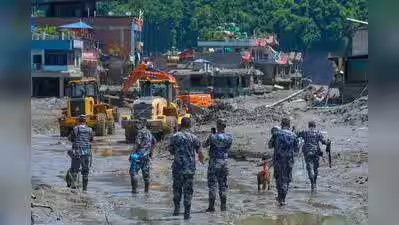
A 54-member pilgrimage group from Panvel, Maharashtra, faced another frightening encounter with nature while returning to Kathmandu after narrowly avoiding the deadly flash flood that struck the China-Nepal border region in August.
The members of the Pratibha Astrology group returned to Mumbai on Thursday after an arduous journey that included swollen rivers, difficult mountain roads, high-altitude conditions and an unexpected landslide.
Their return from the Kailash region to Kathmandu took nearly 18 hours to cover roughly 500 km. At one point, a landslide came down directly in front of their bus, forcing the group to rely on Sherpas and local residents to negotiate dangerous stretches where parts of the road had effectively disappeared.
Group narrowly missed August 26 disaster
The pilgrims said they had a particularly close brush with the flash flood that devastated the Timure-Rasuwagadhi border area on August 26.
Their China visas arrived just one day before the disaster. Had the documents been delayed, the group could have been in Timure when the flash flood struck.
By then, the pilgrims had already crossed Kyirong and travelled farther uphill towards Kailash. News of the disaster left the group shaken and prompted changes to their travel plans.
The group later reached Saga, around 230 km beyond Timure on the Chinese side, where altitude and low oxygen levels became another concern.
High altitude forced changes to Kailash pilgrimage
The group spent nearly three days in Saga, including two days resting to acclimatise before continuing towards Kailash.
The pilgrims eventually reached the destination and completed darshan at Mansarovar. However, they had to shorten their pradakshina after Sherpas warned them about dangerously low oxygen levels.
The difficult conditions did not end with the pilgrimage.
During their return towards Kathmandu through an alternative route, the group encountered swollen rivers, rough roads and stretches of high-altitude terrain that made travel particularly challenging.
Landslide adds to difficult journey
The most alarming moment came when a landslide struck the road directly ahead of their bus.
For the travellers who had already narrowly avoided the flash flood disaster days earlier, seeing debris come down across their route created another moment of panic.
Local residents and Sherpas helped the group cross difficult sections, particularly areas where the road had been damaged or was no longer clearly passable.
Dipti Dilip Bhosle, a 62-year-old retired teacher from Sangli who was part of the group, described the journey as difficult, with swollen rivers and extremely rough roads along the route.
Meanwhile, search and identification efforts for people still missing after the flash flood continue.
Of the 64 Maharashtra residents reported missing, DNA samples from relatives of 51 people have been collected. Families of 13 others are yet to provide samples, with some relatives reportedly travelling abroad.
Most of those still missing are associated with the Hills and Trails group led by Dr Milind Chitale.
For the 54 Panvel pilgrims who returned safely, the journey became a series of narrow escapes, from the flash flood they missed by a day to the challenges of extreme altitude and finally a landslide that blocked their route to Kathmandu.
Mumbai Weekly Staff
Editorial correspondent reporting on national and global stories for Mumbai Weekly.
More In India
View All India →
Prof. Dr. Arjun Chavan: A Scholarly Career Rooted in Hindi Literature and Research
After 38 years as a Professor and Head of the Hindi Department at Shivaji University, Kolhapur, Maharashtra, Prof. (Dr.) Arjun Chavan continues his literary work as an independent scholar and author. His career has covered Hindi literature, comparative literary studies, translation, research methodology, poetry, editing and academic research.