
Florida Uses AI-Powered Robot Rabbits to Track Burmese Pythons
Florida is using solar-powered AI robot rabbits to attract and detect invasive Burmese pythons in the Everglades. The technology works alongside existing python removal programmes and uses heat, scent simulation and cameras to alert trained removal agents when snakes approach.
Key Takeaways
- Strategic developments align with India's long-term infrastructure and technology trajectory.
- Institutional market observers point to sustained corporate expansion and regulatory certainty.
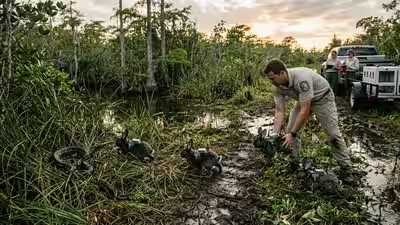
Florida has turned to an unusual piece of technology in its fight against invasive Burmese pythons. Solar-powered robot rabbits are being deployed in South Florida to imitate prey, attract snakes and help officials locate the invasive reptiles in areas that can be difficult to monitor.
The project is being carried out by the South Florida Water Management District and the University of Florida. The robotic rabbits combine artificial intelligence, cameras, heat signatures and scent simulation to detect approaching Burmese pythons and alert officials.
The robots are intended to support existing python removal efforts rather than replace them. Florida continues to use trained contractors and public participation programmes to reduce the invasive snake population.
How the AI robot rabbits detect pythons
The robotic devices are designed to resemble prey that Burmese pythons hunt in the wild. They generate a heat signature and release a scent intended to make the robots more attractive to the snakes.
An AI-powered camera continuously monitors the area around each robot. When a python approaches, the system sends an alert to officials with the South Florida Water Management District.
A trained python removal agent can then be sent to the location to capture and remove the snake.
The robots are being placed at locations across South Florida where Burmese pythons are known to hide. The approach could also help officials monitor areas where conventional surveys are difficult.
The South Florida Water Management District said the robots combine heat and scent cues with cameras to attract pythons and notify officials when a snake is detected.
Why Florida is trying to control Burmese pythons
Burmese pythons were introduced into the Everglades in the 1970s and have since established themselves as an invasive predator in Florida.
Researchers estimate that between 100,000 and 300,000 Burmese pythons are present across the state's subtropical regions. The snakes can grow beyond 18 feet in length, while adult females can lay more than 70 eggs in a single clutch.
Their expansion has affected native wildlife, including mammals, birds and reptiles. The decline in prey species has also raised concerns for predators such as Florida panthers, bobcats and birds of prey.
A 2012 US Geological Survey study cited in the report found that raccoon and opossum populations in some parts of the Everglades had fallen by nearly 99% following the spread of Burmese pythons.
Florida Python Challenge continues alongside robot programme
The robotic rabbit project is one part of Florida's wider strategy to remove invasive pythons.
The annual Florida Python Challenge brings together professional and amateur participants for a 10-day removal competition. Participants must complete a safety course before taking part.
In the 2026 competition, 907 participants from 30 US states, as well as Vietnam and Canada, removed 280 Burmese pythons. The overall number of snakes removed through the competition has now crossed 1,600.
Tom Rahill won the $10,000 grand prize after removing 96 snakes. Rahm Levinson received $1,000 for capturing the longest python, which measured 16 feet, five inches. Other prizes were awarded in professional, novice and military categories.
Florida Fish and Wildlife Conservation Commission chairman Rodney Barreto said the 2026 challenge demonstrated what could be achieved through partnerships and public participation in efforts to protect native wildlife.
More than 19,000 pythons removed since 2017
Florida's python removal programme has already resulted in the removal of more than 19,000 snakes since 2017 through contractors working with the Florida Fish and Wildlife Conservation Commission and the South Florida Water Management District.
The AI-enabled robot rabbits add a technology-based monitoring method to those ongoing efforts. Instead of relying only on people searching for snakes, the robots are designed to draw pythons toward monitored locations and automatically alert officials when they are detected.
The project gives Florida another tool to monitor one of the Everglades' most persistent invasive species while continuing its established removal programmes.
Mumbai Weekly Staff
Editorial correspondent reporting on national and global stories for Mumbai Weekly.
More In Tech
View All Tech →
WION Launches World Conferences Platform to Bring Global India Conversations Together
WION, the global news platform of Zee Media, has announced WION World Conferences, a series of summits and high-level forums focused on issues connecting India with global developments. The platform will cover AI, defence, tourism, sustainability, trade, education, diplomacy and the future of work, with events planned across India, Asia and Africa.