
Satya Niketan PG Building Collapse Raises Structural Safety Questions
The collapse of a more than 40-year-old paying guest building in Delhi's Satya Niketan has raised questions about structural safety, water accumulation, ongoing renovation and additional floors reportedly added over time. Police and civic authorities are investigating the incident, while the Delhi government has announced plans for periodic structural audits of ageing buildings used by the public.
Key Takeaways
- Strategic developments align with India's long-term infrastructure and technology trajectory.
- Institutional market observers point to sustained corporate expansion and regulatory certainty.
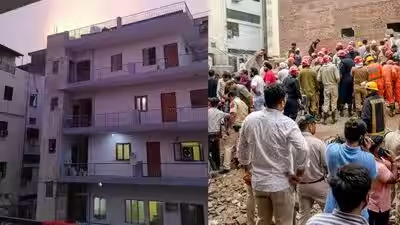
A deadly building collapse in Delhi's Satya Niketan has raised fresh concerns over the safety of ageing structures being used as paying guest accommodation.
The building, which was more than four decades old, collapsed after a period of heavy rain and amid ongoing repair work. Preliminary accounts have pointed to several possible contributing factors, including water accumulation in the basement, construction activity and the structural condition of the old property.
The exact cause has not yet been established. Police and civic authorities are continuing their investigations, while a magisterial inquiry is also expected to examine the circumstances surrounding the collapse.
Waterlogging and repair work under investigation
Delhi Chief Minister Rekha Gupta, after visiting the site, said the building was very old and suggested that ongoing repair work combined with accumulated water had contributed to the collapse.
Police said renovation work was allegedly taking place on both the ground floor and basement before the structure came down. An FIR has been registered against the alleged owner and others as investigators examine whether the work affected the building's stability.
The Municipal Corporation of Delhi is also examining whether heavy rainfall and water seepage weakened the structure.
Officials have cautioned that it is too early to identify a single cause. The investigation is examining the building's structural condition along with possible damage linked to water, basement work and construction activity.
Old construction and additional floors raise questions
The building's construction history has also come under scrutiny.
A local resident said the property belonged to an older cluster in Satya Niketan, where many structures were built decades ago and later expanded by adding floors.
The resident claimed the collapsed building did not have pillars and said work was underway in the basement, where water had accumulated. Such accounts are now being examined alongside official findings.
Former Delhi Fire Services director Atul Garg said heavy rain and construction activity can both increase the risk of failure in an ageing structure. He said the presence of both factors made the situation particularly concerning.
Garg also pointed to the building's original residential use and its later expansion and conversion for commercial purposes, raising questions about whether the structure was adequately equipped to support the changes.
Residents thought an earthquake had struck
The collapse happened suddenly, leaving residents with little time to react.
Roshan Pal, a student from Lucknow, said the ground appeared to shake and that he initially thought an earthquake had occurred. Another resident, Rahul Gaur, described seeing a large cloud of dust spread through the area immediately after the structure collapsed.
People trapped under the debris reportedly shouted for help as residents and students rushed to the site.
Before heavy rescue equipment could fully reach the location, locals formed human chains and began removing smaller pieces of debris by hand. Some residents arranged oxygen cylinders and attempted to provide oxygen through openings in the rubble.
The early response involved students and local residents working together to create paths through the debris and assist rescue teams.
Students and organisations join rescue efforts
The building was being used as a PG for students, prompting universities and student groups to respond.
Delhi University was working to determine how many students were living in the building. South Campus director Professor Rajni Abbi said colleges had been asked to identify students staying in the Satya Niketan area and take steps to ensure their safety.
Volunteers from student organisations including ABVP, NSUI and AISA also participated in the initial rescue operation.
DUSU president Aryan Maan said he reached the site shortly after the collapse and helped mobilise student volunteers from South Campus to assist with rescue and evacuation efforts.
Delhi plans structural audits for ageing buildings
The collapse has renewed attention on older buildings in Delhi, particularly properties originally constructed for residential use that are now being used as PGs or other commercial establishments.
The Delhi government has announced plans for mandatory periodic structural audits and safety certification for old buildings used by the public.
The measure comes as authorities investigate whether the Satya Niketan building's age, alterations, maintenance condition, water accumulation and ongoing repair work played a role in the tragedy.
For now, officials have not attributed the collapse to one confirmed factor. The police investigation, civic assessment and magisterial inquiry will determine the responsibility and establish what caused the structure to fail.
Mumbai Weekly Staff
Editorial correspondent reporting on national and global stories for Mumbai Weekly.
More In India
View All India →
Prof. Dr. Arjun Chavan: A Scholarly Career Rooted in Hindi Literature and Research
After 38 years as a Professor and Head of the Hindi Department at Shivaji University, Kolhapur, Maharashtra, Prof. (Dr.) Arjun Chavan continues his literary work as an independent scholar and author. His career has covered Hindi literature, comparative literary studies, translation, research methodology, poetry, editing and academic research.